How microhomes could help rebuild Ukraine
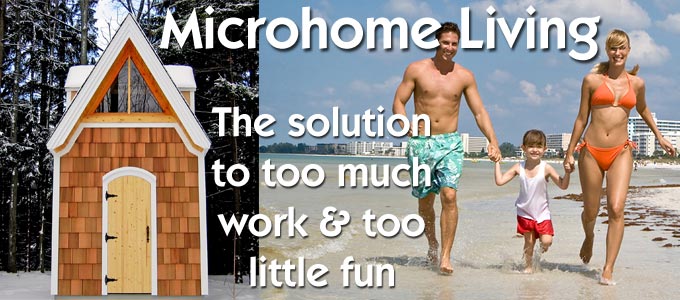
Assuming it survives as a nation, Ukraine will face two problems stemming from its savage destruction by Russia: the competing needs to strengthen their armed forces and rebuild. Microhomes could be constructed rapidly and at very little cost (almost free, in many cases), providing shelter as more conventional infrastructure is restored.
Microhomes could provide a new way of life, but people raised in needlessly large homes generally can't conceive of anything but conventional structures built in conventional ways.
That brings me to my next point: I hear lots of talk about solving the affordable housing crisis but little action. Example: after watching the president of a local Chamber of Commerce on television discussing this problem a day before a local summit addressing it, I contacted her via e-mail offering to help by revealing how homes of any size can be built for markedly less than they are now. I never heard from her.
“Men have become the tools of their tools.”
— Henry David Thoreau
Buying a home is similar to getting married: you fall in love, you gotta have it, so you enter into a long-term commitment blinded by love's ability to trivialize flaws you later pay dearly for, monetarily and otherwise. Regret eventually restores your judgment, but as you wonder “What was I thinking?” there is often no cogent answer to explain your prior infatuation. Regardless of how much your passion cools, you're still stuck with it.
Houses are often called "money pits" because they consume so much money in so many ways that homeowners are often financially drained after paying for the mortgage, property taxes, insurance, utilities, cleaning, maintenance, repair, pest control, moving expenses, and many fees and taxes associated with buying or selling a home.
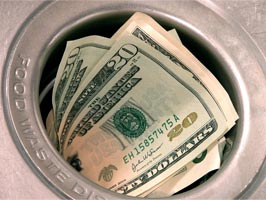
People often take comfort in how the mortgage interest deduction reduces their income tax liability, but they get back only a fraction of what they paid. Spending $100 to get $25 back is hardly cause for celebration. Cameron Huddleston, a Kiplinger.com contributing editor who focuses on personal-finance topics, was shocked by the true cost of home ownership.
Folks who are less financially savvy are more likely to be blown away—perhaps even devastated—by those expenses. One analysis in The Wall Street Journal found that a home purchased for $290,000 in 2007 will really cost its owner over one million dollars. Think of how many decades of full-time work it would take you to make that much money; is it really worth it?
I think the answer is a resounding "no" even in good economic times. During tough times, such as the current recession that is bound to get much worse, owning a traditional (non-micro) home is a great way to ensure that you lose lots of money. The average home lost 28% of its value after the real estate bubble collapsed in 2008, but prices may fall even more.

However, there is a silver lining in this cloud. By owning an unusually small home—a microhome—you can make money from it and have a wonderful life with lots of free time and fun instead of working like a dog and worrying about money. If you're tired of the rat race or are looking for a way to prosper when others will be struggling for many years to come, read my free e-book, Microhome Living. It doesn't contain any viruses, adware, spyware, or other catches—I am a doctor, not a spammer.
Incidentally, as a doctor, I know that the stress level has skyrocketed since the subprime mortgage crisis revealed how inept our politicians are in managing the economy. However, the subprime mortgage crisis is just the tip of the iceberg. I spent a few months researching our economic crisis and found other cancers lurking in our economy that will make the subprime mortgage fiasco seem like the good old days. If you read my other free book, From Bailout to Bliss, you'll understand why we're headed for some very rough times, but you will also see that there are ways for us, individually and collectively, to sidestep much of the fallout from this crisis.

No education is complete unless it teaches kids to have better lives
Education should cover more than the Three Rs, and it does. Teachers and professors find plenty of time to educate children on subjects of questionable value, yet kids are very rarely informed of alternatives to the current system, which is tantamount to economic enslavement. People who work hard for decades often have little to show for it, living paycheck to paycheck, with their most valuable assets (homes and cars) usually owned by banks that are eager to repossess them after a few missed payments.
Accompanying this financially fragile state is frequent anxiety as people worry about paying their bills. People who live in countries that supposedly revere freedom typically are never given a minute of instruction on how they could have more of it. Instead, young people are indoctrinated into thinking there is no alternative to wrapping a ball and chain around their ankles, saddling themselves with debt, bills, and more bills. Most experts say that consumers are dangerously in debt, but so are many countries, including the United States that once seemed destined to be the world's indomitable economic superpower in perpetuity, but now seems certain to economically implode.
People who can learn from mistakes should have learned long ago that living a life based on debt is not conducive to happiness, personal financial security, or national financial security. There is a better way, but with rare exceptions, educators refuse to give it. Like men who try to have two girlfriends but end up with none, people who try to have too much too soon by financing it with debt usually end up with less stuff but more headaches and worries, while those who initially try to have less can end up with more possessions and security. This may seem to be a paradox, but it's not; it is an utterly basic consequence of economic reality—so basic one must wonder why educators don't teach it.
Our culture indoctrinates us into thinking that overconsumption is the only way to go. Besides living in needlessly large homes, we drive needlessly large cars. Newsflash: 150-pound people do not need 4000-pound vehicles to transport themselves! Cars should be not much larger or expensive than go-carts. Need to haul more people or stuff? Add on a trailer, or simply extend one from the car that collapses into it when not in use. True microcars would be much less expensive to purchase, insure, maintain, store, and fuel, so they would have much less of a negative impact on the environment, and they would be more fun to drive. With a microhome and microcar, but without a monthly mortgage payment and car payment, you could work from home or work much less, so your need to travel would plummet.
Related books
Affluenza: The All-Consuming Epidemic
Affluenza: How Overconsumption Is Killing Us—and How to Fight Back
Microhomes help storm-ravaged communities recover
Natural disasters, such as Hurricane Katrina and tornadoes that virtually wipe towns off the map, often permanently break up communities and households. Rebuilding typical homes can take months to years, especially when local resources are stretched too thin. In contrast, microhomes can be constructed in less than a day. Microhomes require far fewer material and labor resources, enabling families and communities to quickly reestablish.
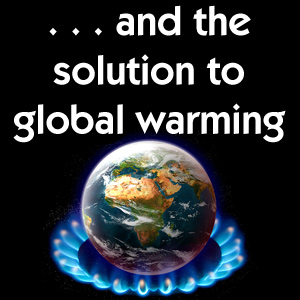
Microhomes: an immediate solution to global warming
I don't know if global warming is real. I don't follow the science or have any expertise in this area. Personally I'm skeptical after seeing year after year of increasingly cold weather in my area that makes me crave warmer weather more than I do cookies, cakes, and pies. I realize that such local observations are not a sufficient foundation upon which to draw global conclusions, but when I freeze an extra two months per year, I'm bound to question what I once wrote on this topic:
Even if you doubt that global warming is real, you don't know that with certainty and can't prove it. Now that even some die-hard, Koch-funded scientific skeptics admit they were wrong, the dwindling pool of global warming deniers should consider the possibility they're mistaken. If they are and we continue on our present course or anything like it, our goose is cooked.
At the risk of delving into a political discussion that ignites my opponents into making up all sorts of nasty lies about me, as a former global warming staunch skeptic, I'll give a bit of insight into how I once thought, and how others still do: the desire to dismiss global warming is motivated by a desire to keep doing what we've been doing. People derive so much comfort from societal and personal inertia that they even resist changes that benefit them at no cost (example).
People are also more likely to dismiss global warming if they think it is yet another excuse for government to control us and take more of our money, but governments are so adept at that they no longer need plausible excuses; they just do what they want and people grumble but comply. Why generate an elaborate hoax when might makes right brute force gives governments the power to do whatever they want?
After many years of thinking that global warming was hogwash, and writing about what I opined to be a Machiavellian deception, I must sheepishly admit that I was wrong, or at least probably wrong. When we're gambling with the future of our planet and the lives of the untold billions of people who will inhabit it, it isn't wise or ethical to dismiss the possibility that global warming is real.
Humans are notoriously poor at assessing risk. Men who consider themselves wise would reject a chance to sleep with a beauty queen if there were a 10% chance she were HIV+ and they knew the risk of transmitting that virus through vaginal intercourse was much less than 1% (sources: 1, 2, 3). Thus even with a 99.9+% chance of safety, the small remaining risk would compel wise men to not take it.
However, with much less certain odds of safety and with much more at stake, many people who think they're wise are willing to gamble they're not wrong. Deep down, they know they're not 100% certain of being correct, but whatever their motivation is for burying their head in the sand, they dismiss that risk while rejecting lesser ones such as the beauty queen. Then if they're like Rush Limbaugh, they pat themselves on the back for being logical while jetting around the country to watch football games. That's not very logical.
One thing is absolutely certain: humans are adversely affecting the Earth in myriad ways. Our tendency to discount the future primes us to often ignore it; we'll take small pleasures now even if there is a heavy price for them in the future. Limbaugh knows he will be dead long before your grandchildren bake in the heat he helped create by flying around the country in his private jet, so he turns a blind eye to the evidence, just as I once did.
The mainstream approaches to combating global warming don't make enough dent in it. We need something simpler, less expensive, with a greater impact. Microhomes can do that because they serve as the nidus for downscaling our lives that have mushroomed out of control in a frenzy of consumerism fueled by energy that ultimately gives us a warmer, more polluted planet.
UPDATE May 16, 2014: It's snowing in Michigan, as it did yesterday. This is the eighth cold month in a row: October, November, December, January, February, March, April, and now May. Global warming?
Related articles
Want to wrap a ball and chain around your ankle? Buy a typical home!

New York Times article: You Can't Take It With You, but You Still Want More
The £180 billion bill for living in a material world: Material lifestyles not making us happier
James Altucher: 10 Life-Changing Decisions We Make Without Thinking: College, homes, marriage, children, jobs, luxuries, and more.
Wall Street Journal article: Cities Try to Lure Young Professionals With Cheap 'Micro' Units: Officials in many of the nation's most expensive housing markets have embraced 'micro apartments'
Tiny houses a way off the streets for Wisconsin homeless
Read similar stories about the microhome movement >
Answering the #1 objection to microhome living
Q: I am very interested in the microhome living concept. I am tired of pouring my money into my money pit of a home, and more than anything else, I would love to spend my life doing what I want instead of working to support my money pit, which also consumes a lot of my free time. You know: cleaning it, maintaining it, and repairing it—not my idea of a good time! Just one problem: How do I squeeze my stuff into a microhome?
A: Most of the space requirements for homes stem not from the space we occupy but from the space occupied by our stuff. In a typical home, most of the stuff is rarely or never used. We tend to keep items around on the off chance we might use them again, but most stuff just accumulates dust year after year, decade after decade. By discarding, donating, or selling items you likely will not use, almost everyone could comfortably fit into a microhome. On those rare occasions when you need something you previously parted with, you will have saved so much money by living in a microhome that you could easily afford to buy a new version of whatever you need.
Secondly, microhome living need not be dollhouse living. If you require more space, you can have more total square footage than a traditional home, yet at much lower cost. You CAN have your cake and eat it, too! :-)
More space at less cost? How?
• Store your stuff in adjacent microhomes that are more shed-like than home-like. I enjoy being in a beautiful home, but my books don't mind the absence of insulation, drywall, fancy trim, expensive windows and floors, plumbing, heating, and electricity. Ditto for the 95% of my clothes that I never or rarely wear, the kitchen gizmos that no longer seem like such a good idea, and so on.
• By building your own microhomes, you can have more total square footage at less cost than a traditional home even if you insist on making all of your microhomes as fancy as standard homes, or even more upscale. If you harvest your own wood as described in the book, you can have Bill Gates quality at a cost that would not faze a McDonald's trainee. Most people would find it difficult or impossible to build a typical home, but they could easily master the basic skills required for microhome construction.
• Microhome living doesn't just save you money on your home but also the countless expenses associated with it, such as utilities and insurance.

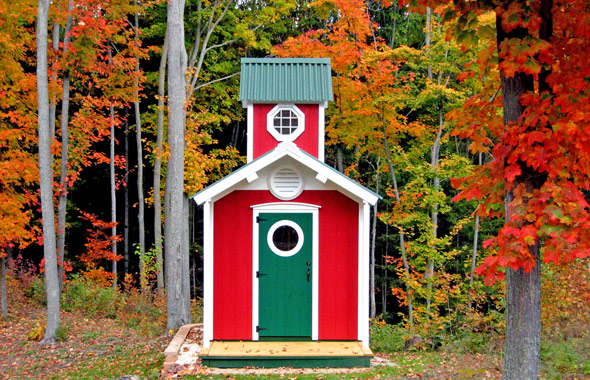
Microhomes are small, but not this tiny! :-)